|
Registered Member
Last Online: 09-02-2009
Join Date: Nov 2006
Posts: 1,784
Thanks: 97
Thanked 166 Times in 115 Posts
Groans: 0
Groaned at 0 Times in 0 Posts
|
 Re: The Hashmite Kingdom of Jordan
Disengagement from the West Bank
Prior to 1989, Jordan’s last parliamentary elections were held in April of 1967, two months prior to Israel’s occupation of the West Bank. Since their union in 1950, the East and West Bank had been allocated equal representation within Parliament: each had thirty representatives in the House of Deputies. The 1967 Israeli occupation of the West Bank, and the 1974 Arab Summit resolution at Rabat, which designated the PLO as the “sole legitimate representative” of the Palestinian people, posed constitutional and practical obstacles to the holding of general elections. On July 28, 1988, King Hussein announced the cessation of a $1.3 billion development program for the West Bank, explaining that the measure was designed to allow the PLO more responsibility for the area. Two days later, he formally dissolved Parliament, ending West Bank representation in the legislature. Finally, on July 31 King Hussein announced the severance of all administrative and legal ties with the occupied West Bank. Accordingly, electoral districts were redrawn to represent East Bank constituencies only. This disengagement decision marks the turning point that launched the current democratic process, and began a new stage in Jordan’s relationship with West Bank Palestinians.
Click here for His Majesty's Address to the Nation, July 31, 1988
The decision to sever legal and administrative ties with the West Bank allowed Jordan’s electoral law to be changed, redrawing the map to include only East Bank districts. During the same period, mounting economic difficulties led to a spate of rioting in certain parts of the Kingdom. Circumstances had therefore coalesced to produce a situation favoring the resumption of the democratic process King Hussein had initiated early in his reign. In November 1989, general parliamentary elections were held in Jordan for the first time since 1966, ushering in a new era for the institutionalization of Jordan’s democratic experience.The Elections of 1989
In April 1989, a caretaker government headed by Sharif (now His Highness Prince) Zeid bin Shaker was entrusted to supervise democratic elections for Jordan’s House of Deputies, thereby strengthening the process of political reform. Censorship was duly lifted and candidates for the lower house began to campaign independently, albeit under the banners of different ideological persuasions. Jordanians went to the polls on November 8, 1989, in the first general elections in twenty-two years. The fairness of the elections was acknowledged internationally and domestically by both winners and losers alike, and King Hussein was given credit for the measures he had taken to secure the return of democracy to Jordan. The electoral guidelines allowed all citizens over age nineteen the right to vote. Jordanian women were allowed to vote, having first gained the franchise in 1974, and were also entitled to seek office.
Although the ban on political parties effected in 1957 remained on the books, candidates ranged ideologically from the extreme left to the extreme right. Most of these independent candidates formed loosely organized blocs according to political inclinations.
 LIST OF JORDANIAN POLITICAL PARTIES
More than 640 candidates, including 12 women, competed for seats in the lower house, which was expanded from 60 to 80 members. The size of the appointed upper house, the House of Notables, was expanded to 40 members. For the first time in the country’s history, the entire spectrum of Jordanian society participated in the legislative branch of government. Since that time, Jordan has continued along the democratic path. Parliamentary elections were held in 1993 and 1997.
Soon after the 1989 elections, King Hussein declared: “To continue Jordan’s liberalization process . . . and to reiterate our deep commitment to defending the human rights and dignity of our citizens . . . we decree that martial laws are cancelled.” Imposed as a result of the tense security situation resulting from the 1967 War and Jordan’s loss of the West Bank to Israel, martial law had preserved the status quo for more than twenty years. With the easing of tensions, the emergency regulations were frozen in 1989, and formally erased in April 1992. This new freedom opened the way for the legalization of political parties and the introduction of new press laws. On July 5, 1992, Parliament formally legalized political parties. LIST OF JORDANIAN POLITICAL PARTIES
More than 640 candidates, including 12 women, competed for seats in the lower house, which was expanded from 60 to 80 members. The size of the appointed upper house, the House of Notables, was expanded to 40 members. For the first time in the country’s history, the entire spectrum of Jordanian society participated in the legislative branch of government. Since that time, Jordan has continued along the democratic path. Parliamentary elections were held in 1993 and 1997.
Soon after the 1989 elections, King Hussein declared: “To continue Jordan’s liberalization process . . . and to reiterate our deep commitment to defending the human rights and dignity of our citizens . . . we decree that martial laws are cancelled.” Imposed as a result of the tense security situation resulting from the 1967 War and Jordan’s loss of the West Bank to Israel, martial law had preserved the status quo for more than twenty years. With the easing of tensions, the emergency regulations were frozen in 1989, and formally erased in April 1992. This new freedom opened the way for the legalization of political parties and the introduction of new press laws. On July 5, 1992, Parliament formally legalized political parties.
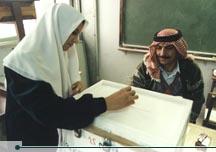 Making it count in the 1997 parliamentary elections. Making it count in the 1997 parliamentary elections.
© Yousef Allan
The National Charter(
In order to place Jordan’s progress to democracy on a stable foundation, a 60-member royal commission was appointed by King Hussein in April 1990 with the aim of drafting guidelines for the conduct of political party activity in Jordan. The commission comprised members representing all the political groups in the country, and it produced a written consensus in the form of the National Charter. The Charter was adopted in June 1991 at a national conference of 2000 leading Jordanians.
The National Charter outlines general guidelines for constructive dialogue between the executive and legislative organs, as well as between decision-makers and political and intellectual elites concerning questions of authority, rights and responsibility. It enunciates the terms under which political parties can operate—namely, within the framework of the Constitution and free of foreign funding—and also emphasizes broad agreement on the need for the political reflection of Jordan’s cultural pluralism. Perhaps most importantly, the Charter has given Jordanian leaders a sense of direction, an insurance policy against outbidding by unrestrained groups, and a degree of predictability in political affairs. It has also eased concerns about the consequences of unbridled freedom of expression. The National Charter, along with the Jordanian Constitution, provides a compass for the national debate on fundamental issues.) In order not to relive the difficulties of the 1950s, a sixty-member royal commission was appointed by King Hussein in April 1990 with the aim of drafting guidelines for the conduct of political party activity in Jordan. The commission comprised members representing all the political groups in the country, and within months produced a written consensus in the form of the National Charter. The Charter was adopted in June 1991 at a national conference of 2000 leading Jordanians. The National Charter outlines general guidelines for constructive dialogue between the executive and legislative organs, as well as between decision-makers and political and intellectual elites concerning questions of authority, rights and responsibility. It enunciates the terms under which political parties could operate -namely, within the framework of the Constitution and free of foreign funding- and also emphasizes broad agreement on the need for the political reflection of Jordan’s cultural pluralism. Perhaps most importantly, the Charter has given Jordanian leaders a sense of direction, an insurance policy against outbidding by unrestrained groups, and a degree of predictability in political affairs. It has also eased concerns about the consequences of unbridled freedom of expression. The National Charter, along with the Jordanian Constitution, provides a compass for the national debate on fundamental issues.
__________________
Tayyar Watany Horr Forever
3ounieh lal mot
|