
|
|
|
|||||||
| Vcoderz Lobby « Everything and everywhere. » |
 |
|
|
Share | Thread Tools | Search this Thread |
 03-05-2007
|
#11 |
|
Registered Member

Last Online: 09-02-2009
Join Date: Nov 2006
Posts: 1,784
Thanks: 97
Thanked 166 Times in 115 Posts
Groans: 0
Groaned at 0 Times in 0 Posts
|
 Re: The Hashmite Kingdom of Jordan
Disengagement from the West Bank Prior to 1989, Jordan’s last parliamentary elections were held in April of 1967, two months prior to Israel’s occupation of the West Bank. Since their union in 1950, the East and West Bank had been allocated equal representation within Parliament: each had thirty representatives in the House of Deputies. The 1967 Israeli occupation of the West Bank, and the 1974 Arab Summit resolution at Rabat, which designated the PLO as the “sole legitimate representative” of the Palestinian people, posed constitutional and practical obstacles to the holding of general elections. On July 28, 1988, King Hussein announced the cessation of a $1.3 billion development program for the West Bank, explaining that the measure was designed to allow the PLO more responsibility for the area. Two days later, he formally dissolved Parliament, ending West Bank representation in the legislature. Finally, on July 31 King Hussein announced the severance of all administrative and legal ties with the occupied West Bank. Accordingly, electoral districts were redrawn to represent East Bank constituencies only. This disengagement decision marks the turning point that launched the current democratic process, and began a new stage in Jordan’s relationship with West Bank Palestinians. Click here for His Majesty's Address to the Nation, July 31, 1988 The decision to sever legal and administrative ties with the West Bank allowed Jordan’s electoral law to be changed, redrawing the map to include only East Bank districts. During the same period, mounting economic difficulties led to a spate of rioting in certain parts of the Kingdom. Circumstances had therefore coalesced to produce a situation favoring the resumption of the democratic process King Hussein had initiated early in his reign. In November 1989, general parliamentary elections were held in Jordan for the first time since 1966, ushering in a new era for the institutionalization of Jordan’s democratic experience. The Elections of 1989 In April 1989, a caretaker government headed by Sharif (now His Highness Prince) Zeid bin Shaker was entrusted to supervise democratic elections for Jordan’s House of Deputies, thereby strengthening the process of political reform. Censorship was duly lifted and candidates for the lower house began to campaign independently, albeit under the banners of different ideological persuasions. Jordanians went to the polls on November 8, 1989, in the first general elections in twenty-two years. The fairness of the elections was acknowledged internationally and domestically by both winners and losers alike, and King Hussein was given credit for the measures he had taken to secure the return of democracy to Jordan. The electoral guidelines allowed all citizens over age nineteen the right to vote. Jordanian women were allowed to vote, having first gained the franchise in 1974, and were also entitled to seek office. Although the ban on political parties effected in 1957 remained on the books, candidates ranged ideologically from the extreme left to the extreme right. Most of these independent candidates formed loosely organized blocs according to political inclinations.  LIST OF JORDANIAN POLITICAL PARTIES LIST OF JORDANIAN POLITICAL PARTIESMore than 640 candidates, including 12 women, competed for seats in the lower house, which was expanded from 60 to 80 members. The size of the appointed upper house, the House of Notables, was expanded to 40 members. For the first time in the country’s history, the entire spectrum of Jordanian society participated in the legislative branch of government. Since that time, Jordan has continued along the democratic path. Parliamentary elections were held in 1993 and 1997. Soon after the 1989 elections, King Hussein declared: “To continue Jordan’s liberalization process . . . and to reiterate our deep commitment to defending the human rights and dignity of our citizens . . . we decree that martial laws are cancelled.” Imposed as a result of the tense security situation resulting from the 1967 War and Jordan’s loss of the West Bank to Israel, martial law had preserved the status quo for more than twenty years. With the easing of tensions, the emergency regulations were frozen in 1989, and formally erased in April 1992. This new freedom opened the way for the legalization of political parties and the introduction of new press laws. On July 5, 1992, Parliament formally legalized political parties.  Making it count in the 1997 parliamentary elections. Making it count in the 1997 parliamentary elections.© Yousef Allan The National Charter( In order not to relive the difficulties of the 1950s, a sixty-member royal commission was appointed by King Hussein in April 1990 with the aim of drafting guidelines for the conduct of political party activity in Jordan. The commission comprised members representing all the political groups in the country, and within months produced a written consensus in the form of the National Charter. The Charter was adopted in June 1991 at a national conference of 2000 leading Jordanians. The National Charter outlines general guidelines for constructive dialogue between the executive and legislative organs, as well as between decision-makers and political and intellectual elites concerning questions of authority, rights and responsibility. It enunciates the terms under which political parties could operate -namely, within the framework of the Constitution and free of foreign funding- and also emphasizes broad agreement on the need for the political reflection of Jordan’s cultural pluralism. Perhaps most importantly, the Charter has given Jordanian leaders a sense of direction, an insurance policy against outbidding by unrestrained groups, and a degree of predictability in political affairs. It has also eased concerns about the consequences of unbridled freedom of expression. The National Charter, along with the Jordanian Constitution, provides a compass for the national debate on fundamental issues.
__________________
Tayyar Watany Horr Forever 3ounieh lal mot |

|

|
|
03-05-2007
|
#12 |
|
Registered Member
Last Online: 09-02-2009
Join Date: Nov 2006
Posts: 1,784
Thanks: 97
Thanked 166 Times in 115 Posts
Groans: 0
Groaned at 0 Times in 0 Posts
|
Re: The Hashmite Kingdom of Jordan
Seeking Peace: Jordan’s Stand in the Gulf Crisis Political and social upheaval shook the Arab world again when, on August 2, 1990, Iraqi forces invaded and occupied neighboring Kuwait. Due to its proximity to the crisis, its political stand and its role as Iraq’s primary trading partner, Jordan suffered tremendous losses during and after the Gulf War on both the political and economic fronts. Jordan’s political position during the crisis has been thoroughly misinterpreted, and deserves explanation. Jordan stood in full agreement with the international community that the Iraqi invasion and annexation of Kuwait was a breach of international law which could not be allowed to stand. However, from the Jordanian viewpoint Arab interests dictated that the matter should be settled on a regional basis. Jordan attempted to resolve the matter through the good offices of the Arab League, and King Hussein personally issued vigorous appeals to Saddam Hussein to yield to the demands of the international community. Unfortunately, the intransigent positions of both Iraq and the UN coalition made a negotiated settlement impossible. Despite the political opprobrium and cancellation of economic aid the position brought, King Hussein stood squarely with the wishes of the Jordanian people, who sought to minimize the suffering of their fellow Arabs through a peaceful resolution of the conflict. Aside from Iraq and Kuwait, no state suffered more from the Gulf Crisis than Jordan. With a population of only about three and a half million people at that time, the Hashemite Kingdom hosted over a million refugees from the conflict. While most of these were third party nationals in transit through Jordan, about 300,000 became permanent “returnees” from the Gulf. Many of these “returnees” were Palestinian refugees who benefited from Jordan’s unique policy of granting citizenship to any Palestinian who seeks it. The influx of these refugees led to an increased demand on the country’s limited water supplies and infrastructure, rising poverty and a sharp increase in unemployment to around 30%. Iraq had served as Jordan’s primary trading partner, and the Gulf Crisis and international sanctions against Iraq created severe economic difficulties for Jordan. It has been estimated that the crisis has cost Jordan over three billion dollars in lost trade and declining revenues. Jordan has complied strictly with the UN-mandated sanctions against Iraq, although they have crippled the flow of commerce at the port of Aqaba and disconnected the overland trade route to Iraq. The Jordanian and Iraqi economies, which once prospered because of their interaction, are now effectively disconnected, to the detriment of both peoples. The Madrid Peace Process The early 1990s marked a watershed period in the history of the Arab-Israeli conflict. The Gulf Crisis redefined the balance of power in the Middle East, reshuffled inter-Arab relations and demonstrated once again the need to work toward a just and comprehensive regional peace. Moreover, several other factors converged during this time to produce a situation propitious for pursuing peace. The termination of the Cold War allowed the Arab-Israeli conflict to be treated as a regional problem. This, combined with the international realization that Arab-Israeli peace is necessary for regional stability, provided the spark to re-ignite a hitherto dormant peace process. Sensing a “window of opportunity” following the liberation of Kuwait, the United States and the Russian Federation co-sponsored the Madrid Peace Conference in October, 1991. During the Madrid negotiations, Jordan extended an “umbrella” to the Palestinian delegation, allowing them to negotiate with the Israelis directly for the first time.
Almost two years later, on September 13, 1993, the PLO and Israel signed their Declaration of Principles (Oslo I), outlining a negotiating framework to be followed leading to a final status treaty between the Palestinian and Israeli peoples. This opened the road for Jordan to proceed on its own negotiating track with Israel, and the Jordan-Israel Common Agenda of negotiations was initialled one day after the PLO-Israel Declaration of Principles. On July 25, 1994, King Hussein met with Israeli Prime Minister Rabin in the Rose Garden of the White House, where they signed the Washington Declaration, formally ending the 46-year state of war between Jordan and Israel. The Jordan-Israel Peace Treaty was signed on October 26, 1994, at the southern border crossing of Wadi ‘Araba. The treaty guaranteed Jordan the restoration of its occupied land (approximately 380 square kilometers), and guaranteed the Kingdom an equitable share of water from the Yarmouk and Jordan rivers. Moreover, the treaty defined Jordan’s western borders clearly and conclusively for the first time, putting an end to the dangerous Zionist suggestion that “Jordan is Palestine.” Seeking to lay a firm foundation for a just, comprehensive and lasting peace, the treaty also outlined a number of areas in which negotiations would continue. To this end, Jordanian and Israeli negotiators have signed a series of protocols establishing a mutually beneficial framework of relations in fields such as trade, transportation, tourism, communications, energy, culture, science, navigation, the environment, health and agriculture, as well as cooperatory agreements for the Jordan Valley and the Aqaba-Eilat region. 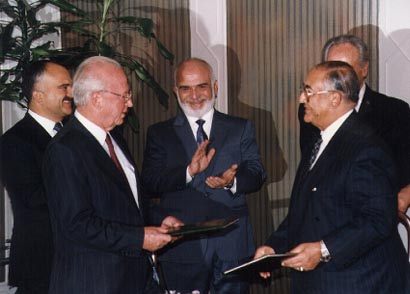 King Hussein, Crown Prince El Hassan, Israeli Prime Minister Rabin, Jordanian Prime Minister Majali and Israeli Foreign Minister Peres exchange copies of the initialed drafts of the Jordan-Israel Peace Treaty, October 17,1994. King Hussein, Crown Prince El Hassan, Israeli Prime Minister Rabin, Jordanian Prime Minister Majali and Israeli Foreign Minister Peres exchange copies of the initialed drafts of the Jordan-Israel Peace Treaty, October 17,1994. © AFP
__________________
Tayyar Watany Horr Forever 3ounieh lal mot |
|
|
|
|
03-05-2007
|
#13 |
|
Registered Member
Last Online: 09-02-2009
Join Date: Nov 2006
Posts: 1,784
Thanks: 97
Thanked 166 Times in 115 Posts
Groans: 0
Groaned at 0 Times in 0 Posts
|
Re: The Hashmite Kingdom of Jordan
The Old Testament Kingdoms of JordanThe Iron Age (c. 1200-332 BCE) saw the development and consolidation of three new kingdoms in Jordan: Edom in the south, Moab in central Jordan, and Ammon in the northern mountain areas. To the north in Syria, the Aramaeans made their capital in Damascus. This period saw a shift in the level of power from individual “city-states” to larger kingdoms. One possible reason for the growth of these local kingdoms was the growing importance of the trade route from Arabia, which carried gold, spices and precious metals through Amman and Damascus up to northern Syria. 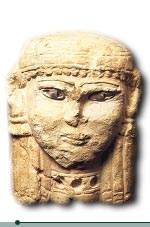 Double faced female head, Middle Bronze Age. © Ministry of Tourism & Antiquities 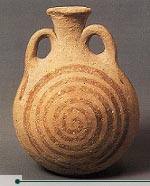 Pilgrim flask, Iron Age, Madaba. © Ministry of Tourism & AntiquitiesThe bulk of the Biblical Old Testament took place during this period. There is little archeological evidence to fully support the Biblical account of the Israelites’ occupation of Palestine. Although archaeologists have demonstrated that certain cities supposedly taken by the Israelites were indeed destroyed during this period, it is equally feasible that they may have been sacked by invading Egyptian armies. It is probable that the “conquest” occurred more gradually than in the Biblical narrative, with the process more akin to waves of ethnic migration than a conventional military campaign. According to the Biblical account of the Exodus from Egypt (c. 1270-1240 BCE), the Israelites requested permission to pass unharmed through the Kingdom of Edom. After having been denied permission, they skirted Edom to the east and continued north until they reached the borders of the Amorite country near Madaba. Not trusting the Israelites’ intentions, and not wishing to place the added strain of thousands of migrants upon his food and water stores, the Amorite leader Sihon refused them passage as well. This time, the Israelites fought back and defeated Sihon, occupying his territory. According to the Bible, the Israelites then continued their northward trek into the Kingdom of Moab, where the Moabite king set up an alliance between the five tribal kings of Midian (the Hijaz of Arabia). The increasingly powerful Israelites triumphed over the Midianites as well, and some of the tribes settled in the conquered territories. The prophet Moses apparently climbed, or was carried, to the top of Mount Nebo, where, according to some sources, he died. Joshua then led the remaining tribes across the Jordan River into Palestine. A united Kingdom of Israel arose there about 1000 BCE with Saul and David as its first kings. After the death of David’s son King Solomon in 922 BCE, the kingdom divided into two, with Israel in the north and Judah in the south. The relative ease with which the Israelites made their way north and west into Palestine says much about the situation in Egypt, which still nominally ruled the lands of Jordan and Palestine. Attacks from the “Sea Peoples” of the Mediterranean Sea had weakened the Pharaonic empire and allowed the Philistines to gain a foothold on Egyptian soil as well as in Palestine and Jordan. The primary contribution of the Philistines to local culture was the introduction of iron working to the region. Their superior skills in weapon-making gave them a military advantage and assisted in their early victories over the Israelite tribes. By around 1000 BCE, however, iron was in widespread use throughout the region. In general, trouble for the Israelites was good news for the kingdoms of Jordan. The split into Israel and Judah in 922 BCE, combined with the invasion of the Egyptian Shishak against Israel four years later, allowed the three kingdoms a bit of breathing room and prosperity. After the death of King David around 960 BCE, Edom regained most of its former independence. The Edomites occupied southern Jordan and their capital at Buseira possessed at least one large temple or palace. They were skilled in copper mining and smelting, and had settlements near modern-day Petra and Aqaba. The Moabites are best known from the Mesha Stele, a ninth-century BCE stone which extols the deeds of the Moabite King Mesha. He won a victory over the occupying Israelites, who were still clearly a major thorn in the side of the Moabites. The Kingdom of Moab covered the center of Jordan, and its capital cities were at Karak and Dhiban. The Kingdom of Ammon around 950 BCE displayed rising prosperity based on agriculture and trade, as well as an organized defense policy with a series of fortresses. Its capital was in the Citadel of present-day Amman. The wealth of these kingdoms made them targets for raids or even conquest by the neighboring Israelites, the Aramaeans in Damascus, and the Assyrians with their capital at Ashur in northern Mesopotamia (modern-day Iraq). From the ninth century BCE on, the Assyrians campaigned against the Aramaeans, and in the late eighth century BCE they captured Damascus as well as Samaria, the capital of the northern kingdom of Israel. The kingdoms of Ammon, Moab and Edom retained their independence, however, by buying the Assyrians off with tribute. The Assyrian Empire came crashing down in 612 BCE, when Nineveh fell to an alliance of Medes of Persia and the Chaldean kings of Babylonia. In its place arose the Babylonian Empire and King Nebuchadnezzar, whose defeat of the Egyptians at Carchemish in 605 BCE threw much of the region into turmoil. Considerable population shifts took place under the Babylonians, exemplified by the Edomites’ migration from Jordan into the area in southern Palestine known as Idumaea. In fact, there was a decline in urban development and power swung back again to nomadic tribes. In 587 BCE, Nebuchadnezzar II of Babylon destroyed Jerusalem and deported thousands of Jews to Babylonia. In 539 BCE, the Persians under Cyrus II ended the disruptive rule of the Babylonian Empire and paved the way for a period of more organized life and prosperity. The Persian Empire became the largest yet known in the Near East, and Cyrus’ successors conquered Egypt, northern India, Asia Minor, and frequently conflicted with the Greek states of Sparta and Athens. Internal turmoil continued in Jordan, with numerous clashes occurring between the Moabites and Ammonites. Jordan and Palestine were placed under the control of a Persian viceroy with subordinate governors. Meanwhile, Cyrus freed the Jews from captivity in Babylonia and allowed them to rebuild the temple in Jerusalem. The Moabites and Ammonites interpreted this as a virtual declaration of sovereignty, and hence organized attacks upon the resettled Jews. They were led in this campaign by Tobiah, whom the Persians had appointed as governor. Tobiah set up a short-lived local dynasty, but ultimately the Persian leader Darius I (522-486 BCE) safeguarded the Jewish community and the temple was rebuilt. After establishing the greatest empire yet known in the Near East, economic decline, revolts, murders and palace conspiracies weakened the Persian throne. In 332 BCE, Alexander the Great conquered the Persian capital of Persepolis (in modern Iran) and established Greek control over Jordan and surrounding countries.
__________________
Tayyar Watany Horr Forever 3ounieh lal mot |
|
|
|
|
03-05-2007
|
#14 |
|
Registered Member

Last Online: 04-15-2018
Join Date: Aug 2006
Posts: 1,549
Thanks: 31
Thanked 213 Times in 151 Posts
Groans: 0
Groaned at 1 Time in 1 Post
|
Re: The Hashmite Kingdom of Jordan
Thanks for the info, I personaly admire Jordan for the economic and cultural growth it is having currently, the Jordan PIB was still smaller then the Lebanese one I think but they have an "augmentation" de chi 10%/an while we where at 3-4% (last year 0 ou -), the % of educated people is bigger or equal to the one in Lebanon. That's one dictator who at least gave something to his people!
|
|
|
|
|
03-06-2007
|
#15 |
|
Registered Member

Last Online: 12-28-2011
Join Date: Sep 2006
Posts: 2,664
Thanks: 377
Thanked 959 Times in 569 Posts
Groans: 1
Groaned at 4 Times in 2 Posts
|
Re: The Hashmite Kingdom of Jordan
ummmm intersting informations...thanks Ghnadine...
__________________
цари́ца |
|
|
|
|
10-05-2008
|
#16 |
|
Registered Member

Last Online: 10-14-2022
Join Date: Dec 2006
Posts: 10,467
Thanks: 14,136
Thanked 4,244 Times in 2,547 Posts
Groans: 186
Groaned at 198 Times in 120 Posts
|
Re: The Hashmite Kingdom of Jordan
fake country .
__________________
problems of performance appraisal is that it sucks to memorize them |
|
|
|
| The Following User Says Thank You to SysTaMatIcS For This Useful Post: | majousseh (10-06-2008) |
|
10-06-2008
|
#17 | |
|
Community Moderator

Last Online: 06-23-2013
Join Date: Dec 2006
Posts: 14,267
Thanks: 7,236
Thanked 8,442 Times in 4,889 Posts
Groans: 31
Groaned at 29 Times in 23 Posts
|
Re: The Hashmite Kingdom of Jordan
Quote:
Euhhhh why r u saying that????
__________________
If my smoking bothers you. Don't breathe.  |
|
|
|
|
|
10-06-2008
|
#18 | |
|
Vcoderz Team

Last Online: 05-31-2021
Join Date: Apr 2006
Posts: 3,915
Thanks: 3,184
Thanked 2,546 Times in 1,373 Posts
Groans: 59
Groaned at 23 Times in 17 Posts
|
Re: The Hashmite Kingdom of Jordan
Quote:
يا زلامي انت مش طبيعي
اش عرفك انو فيك كونتري هيدي ؟؟؟ لازم نسميك رجل المريخ انت |
|
|
|
|
|
10-06-2008
|
#19 |
|
Registered Member
Last Online: 10-14-2022
Join Date: Dec 2006
Posts: 10,467
Thanks: 14,136
Thanked 4,244 Times in 2,547 Posts
Groans: 186
Groaned at 198 Times in 120 Posts
|
Re: The Hashmite Kingdom of Jordan
ask Mr. sayks and Mr. beeko and theyll tell u why . + the jordanians are more than like 300,000 people there.
__________________
problems of performance appraisal is that it sucks to memorize them |
|
|
|
|
10-06-2008
|
#20 | ||
|
Vcoderz Team

Last Online: 04-15-2018
Join Date: Jan 2007
Posts: 652
Thanks: 768
Thanked 983 Times in 468 Posts
Groans: 14
Groaned at 4 Times in 4 Posts
|
Re: The Hashmite Kingdom of Jordan
Quote:
 ) )Quote:
Never, NEVER a dictator gives more than he takes |
||
|
|
|
| The Following User Says Thank You to majousseh For This Useful Post: | SysTaMatIcS (10-06-2008) |
|
|
| Tags |
| hashmite, jordan, kingdom |
| Currently Active Users Viewing This Thread: 1 (0 members and 1 guests) | |
|
|


